Showing posts with label "Michelle Alton". Show all posts

Thursday, November 17, 2011

Fish Tales...Part 2

Bob Cammarata
Even if you are already a fan of Bob Cammarata's stories
( On Snake Mountain , Next Stop OzWhen Mother Nature Lends a Hand and Fish Tales...Part 1) you are going to discover a new, fresh, and hilarious side of Bob in "Fish Tales...Part 2."

I find his writing to be like a precision tool--every word and phrase carefully chosen to produce the perfect result--and in this case, written with tongue placed firmly in cheek to create maximum enjoyment.  You won't believe the lengths he has gone to in Relentless Pursuit of "the shot!"

And even though this story is a joyful riot, I'm told (by "agent" Carolyn Fletcher) that the next one will knock your socks off!


________________

Thanks for stopping here to view the latest post. What do you think of  this story?  Please leave a comment below for Bob and if you have a moment email me with your suggestions on what you'd like to see on this blog.

Also, I'd very much appreciate a click on the green SU icon at the bottom of this post, to recommend the blog to Stumble Upon members. It will dramatically increase the "exposure" of our authors' work.

If you have a story to post on this theme, contact me. And be sure to take a look at my Photography Site. Also consider forwarding the link to "Relentless" to your friends and family. Thanks again!
--
Michelle Alton
___________________

FISH TALES…Part 2 (Anything for a Photo)
By Bob Cammarata

What do a fish, a camera, and a stick of chewing gum all have in common? The mind could easily become clouded in confusion trying to figure out how these three seemingly incongruous elements could possibly be linked together.  If I’ve piqued your interest enough to read on, the answer to this puzzling question can be found in this latest installment of Fish Tales.


If you’ve read Part 1, you know that much of what I’ve learned about photography can be attributed to my angling years, exploring and experimenting with various remote control gadgets and techniques in relentless pursuit of that perfect trophy trout or bass photo. You also learned that my infatuation was fueled by the need for action sequences to augment my “fish talks” and slide shows. Deep down within the recesses of my gut, I was also obsessed with the aspiration that one day millions of folks might be seeing one of my creations gracing the front cover of Field and Stream. Though that was a dream never realized, in looking back, it sure was fun trying.

In those days, one of the most prolific gadgets in my arsenal was my trusty Quantum Radio Slave.

Radio Slave Remote with Motor-Driven Film Camera
This versatile tool was acquired back in the late 80’s and accounted for most of my simulated action photos while fishing. With a cord linking it to my motor drive, it was possible to remotely activate the camera from up to 200 feet away.

It’s worth mentioning that a lesson painfully learned back then was that the clandestine nature of catch and release trophy trout fishing in local streams necessitated fishing alone almost all of the time.

So as one might imagine, attempting to shoot action sequences in the field while alone was truly beset with many challenges and learning experiences. Since in those days I was shooting slide film exclusively, my delete file was a large, ravenous refuse receptacle…who’s home was just to the left of my light table. (I called him “Mr. Happy”.)

The learning curve needed to be rapidly accelerated by the fact that every time my finger touched the remote trigger, it ended up costing me around 23 cents in film and processing.

Yeah,…Mr. Happy was one happy guy!

A Happy Feast
Among the many challenges incurred during what was an arduous learning process, composition was one of the easiest to overcome. (…after I’d fed “Mr. H.”. a few rolls of slides with only part of the fish showing, and/or, with my head cut off.)

I eventually learned to compose my scenes more effectively and economically by including a pre-determined, physical point of reference. If no such reference point existed, a stick was jammed into the stream bed where I would later be standing with my prized catch. As for the height issue…well, that was pretty much a guess.

Where's the Rest of my Head?

It was vital that the focus, composition and exposure were all pre-set perfectly since, if either was off by even the slightest of immeasurable margins, EVERY SHOT in the sequence would end up adding more sustenance to Mr. Happy’s insatiable appetite.

Another obstacle which needed to be addressed was the simple fact that the protracted set-up procedure had to be performed AFTER a fish was caught, so a fool-proof system had to be developed to keep the fish alive and healthy so it could be released once the brief photo session had concluded.

A small meshed laundry bag, which was carried in my fishing vest, was the perfect solution to this dilemma. After its capture, the fish was eased gently into the bag, which was then placed back into the stream.

This simple live-bag system actually served a double purpose. Not only did it permit ample time to set up everything and test-fire the remote, it allowed a larger fish a little extra time to recover from a long fight and regain its stamina before it was ultimately released into heavy current.

Released
In practice, the Radio Slave receiver would hang freely onto one of the tripod legs affixed with a little piece of Velcro. Since the trigger was so small and easy to conceal, it was common practice to hide it inside of a pocket on my fishing vest….where it could be covertly and nonchalantly activated. This system worked very well…sometimes!

Small Stream Action
The primary drawback was that one hand was always required to activate the remote trigger…leaving only one free hand to try to control a lively and slippery trout, which was usually pretty P.O.’d and intent upon escaping. More often than not, my prize catch would scoot out of my hand and disappear before I could get off a shot.

In an attempt to combat this all-too-common dilemma, I started shopping around for yet another gadget. A Wein SST Super Sound Trigger was eventually selected as the possible answer to my prayers.  With this newest remote-control unit, it would hopefully become possible to activate my camera by means other than by manually pressing a button…thus, leaving both hands free to control the action. Aside from attempting to grow another appendage, this seemed like the most practical course of action to insure that Mr. Happy’s much needed diet plan remained steadily on track.

From what I'd read, the sensitivity of the sound triggering mechanism could be easily adjusted to any level of sound from a whisper to a gunshot, and this nifty device could be accessorized to use that sound to activate a motor-driven camera.
And best of all, proudly listed among my repertoire of unique talents, is the ability to pop chewing gum in my mouth louder than any other civilized person I know. (…what can I say…. “It’s a gift”.)

So when the day finally arrived when my new sound trigger was delivered, I was that proverbial kid in the candy store as I quickly unpacked everything and installed the batteries. With everything set up at the house, and with a viscous gob of Juicy Fruit at the ready, a few “test pops” proved that the new system worked great. It would now be possible to use BOTH hands to control a slippery fish and use the gum to trigger the camera. It was perfect!

“Watch out now, Field and Stream!”

And so the new sound-triggering device and a pack of chewing gum made their way into the ever-growing list of accessories which comprised my combined, and already overloaded, fishing/photography gear bag. (Fortunately, a 5-pack of Wrigley’s didn’t weigh much.)

It was a few months later when I finally had the opportunity to implement the sound trigger for the first time in the field when I happened upon a real hammer while fishing for brown trout at one of my favorite local streams. (For the benefit of the non-fishers, the term “hammer” is commonly used to describe a  trophy catch…that Fish of a Lifetime.)

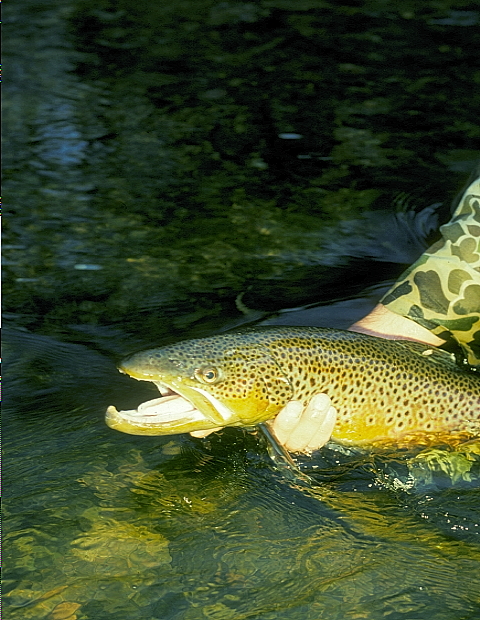
From deep within an undercut root ledge just downstream from an old rickety wooden bridge, the big brown rolled out and took a half-hearted swipe at my lure before vanishing back into the security of its lair. I estimated its weight at over 6 lbs. It was handsome male in full breeding colors and, by local standards…this was a REALLY big fish!

Before attempting another cast, I paused momentarily to fully assess the situation. This was a big trout…one of the biggest I’d ever seen locally. The autumn light was perfect and that wooden bridge surrounded by brilliant fall foliage appeared to provide the perfect background for a full-body shot of me holding this monster trout at streamside. But it would surely take two hands to handle THIS whopper!

Knowing that my new sound trigger was tucked away in my back-pack, I quietly backed up away from the behemoth’s secretive lair and hurried to get everything set up.
The camera and remote receiver were meticulously positioned onto the tripod and the scene was composed to incorporate that picturesque old bridge in the background. All of my prior “learning experiences” were being vitally tested as the aperture/shutter combination was set to insure perfect exposure. A critical focus point was pre-determined by poking a stick into the stream bed where, if premonition and providence prevailed, I would later be displaying my prized trophy.

But while assembling the camera gear and attaching the sound trigger, I noticed with dismay that my pack of gum (my “trigger”) was empty! Apparently, I’d gotten hungry on a few previous trips and had forgotten to replace the pack.

I figured…“No problem….Why can’t I just yell at the darn thing?”

So after everything was in place and all components were turned on, I gave a “test holler” near the sound trigger and was excited and relieved to hear the motor drive advance the film to the next frame. To insure that I would get at least a few good photos from this once in a lifetime session, I re-set the motor-drive to “continuous mode”. (This setting would start the motor-drive on the first sound, and the camera would continue to expose frames until a second sound turned it off.)

OK…now that everything was perfectly set, tested,  and ready to go, the only thing left was the attempt to actually CATCH this beast.

It took nearly a dozen perfectly positioned casts before the obscured trout finally rolled out of its protective root ledge to engulf my lure -- and the ensuing fight was on. The big brown was strong. It thrashed and cavorted with a fury against the pressure of my ultra-light tackle but was eventually subdued. Before long, an exhausted, but beautiful 26” trout was lying at my feet in the clear shallows. After briefly admiring this handsome specimen, I carefully eased the fish into my pre-determined position to get my photos. I kicked away the stick which was marking the position, dropped to one knee and posed photogenically, holding the big trout horizontally at the water’s edge.
I yelled a fairly loud ..“Hey..” but nothing happened.

So I tried a little louder  “…HEY”…and still nothing.

I remember chuckling to myself after briefly glancing around to make sure that there wasn’t anybody watching this inane fool kneeling in a cold creek holding a fish…and yelling at no one
.
Then I yelled louder still “…HEY ..”. But the shutter on the camera still wasn’t being activated.

I finally figured that the decibel level on the trigger was set too low, so my only viable option was to slip the fish into the live bag while I adjusted the sensitivity to a higher level.

As I was sliding the somewhat confused trout into the bag, I heard the sound of an approaching vehicle. This was truly bad news, since where I’d chosen to set up was in plain view from the bridge and I had to be very discrete, so as not to reveal to any of the locals what was actually residing in this tiny, obscure creek. I quickly secured the big trout in the live bag, then cowered behind a bush…hidden from view, as I waited for the vehicle to pass.

It was a fuel truck…and a noisy one.  The truck eventually came into view and bounced raucously across that rickety wooden bridge. The racket it made was loud enough to activate the sound trigger attached to my camera which, if you remember, had been set to “continuous”….and my motor-drive immediately began gobbling film at 3.1 frames per second! I jumped from my hiding place and quickly ran over to turn it off but it was too late. Buy the time I got to where the camera was set up, an entire roll of 36 frames had been consumed. To make matters even worse, I had no back-up rolls with me that day.

After the truck had long passed, I was standing there feeling somewhat dejected, but satisfied as I realized that I was staring down with admiration at one of the biggest trout I’d ever seen! Although I’d failed to produce a single photograph to document the experience, the memory of that magnificent trout on that tiny stream will remain indelibly etched in my mind.

…especially when someone offers me a stick of gum.

--
  All photography by Bob Cammarata

Bob Cammarata's Biographical Sketch

I am a Maryland photographer who specializes in nature in all its forms.
For as long as I can remember, my love for the outdoors has inspired me to capture nature's beauty and intrigue. My primary interests photographically involve traveling the country and getting up close and personal with subjects in nature. My travels have taken me to every corner of the U.S. and parts of Canada but the majority of my photography occurs less than a tank of gas away.
I prefer to shoot in full-manual 100% of the time because I believe that it affords the ultimate in control and accurately represents the challenges and rewards that this great art has to offer. I’m an active member of BetterPhoto.com and a regular contributor to their Forums and Newsletters. My photos have been published in business and travel brochures, on Bugguide and other popular wildlife sites, and many have been sold as fine art prints. I’m currently working on my first book, which should be completed some time next year.

I consider photography to be the therapy which keeps one sane in a crazy world
Feel free to visit my website at www.cammphoto.com


Bonus Photos…A few that didn’t get away!
(Note…All of these were shot using the Radio Slave Remote and were scanned from old Kodachrome slides.)

Flyrodding on the Gunpowder River

Falling Waters

Winter Trout Fishing
               
Landing a Nice Trout
A Hefty Handful
Brown Trout Up Close
__________________________________

Please Note:
*** This Blog Needs Your Story! *** { I'm Serious!} If you have a story to post on this theme, or know anyone who does, contact me, please! We have zero stories on tap at the moment. Give your imagination a stretch--your story can be about any sort of Relentless Pursuit, fact, fiction, poignant, or humorous. I'd love to hear from you and work with you on your story! We need to keep this theme going! If you have a few moments, please stop by my web site and have a look around.
_________________
[Click on the green SU icon below to recommend this blog to Stumble Upon Members]

---------------------- 
    
          
##

Thursday, October 20, 2011

It's All Downhill From Here

Art Rosch
Art Rosch is the second author to be suggested to me by Carolyn Fletcher, and all I can say is "She knows some fantastic writers and fascinating people!

I contacted Art and asked him if he would be interested in participating in "Relentless Pursuits" and he enthusiastically agreed to provide a story!

And WHAT A STORY!  It is truly a tale of  relentless striving for survival!  I am a hopeless acrophobic and have long suffered from a recurring nightmare that is astonishingly close to the true-life nightmare that is described in Art's story "It's all Downhill From Here."

His writing will absolutely rivet you and if you're anything like me, you may even be gasping for breath by the time you reach the end of the story. 

The side story about Art's wife, Fox, is a whole other experience, and one you will not want to miss,  It has stuck in my imagination since my first reading of the story!

By the way, "It's all Downhill From Here" also appears in Art's superb book, Avoiding the Potholes.
--
  Michelle Alton

________________________

Thanks for stopping here to see the latest post. I'd love to know what you think of the "Relentless Pursuit" series. Please leave me a comment below or email me with your suggestions on what you'd like to see on this blog. Also, PLEASE click the green SU icon at the bottom of this post to recommend the blog to Stumble Upon members. It will dramatically increase the "exposure" of our authors' work.

If you have a story you would like to share on this theme, contact me. And be sure to take a look at my Photography site. I'd love to hear from you! Also, consider forwarding the link to "Relentless" to your friends and family. Thanks again!
____________________________________

It's All Downhill From Here
     By Art Rosch - Copyright 2011

Sunset At Fremont Peak. It was just one of those moments.

Sometimes, I wonder why people consider travel to be fun.  There is so much work to be done, so much organization, so many details, so much hurry.  Then, after the hurry, comes boredom and discomfort.  Somewhere in between all this nerve-chewing stuff is the so-called "fun".

My wife Fox and I were attempting to refine the process of travel.  We thought going in an RV was the ideal method.  Regardless of the efforts, we needed to travel!  I’m a photographer, an astronomer.  My goal on this trip was to take long exposure shots of the Milky Way.  I needed dark and pristine skies to achieve my images.

Yosemite Star Trails. Taken at Glacier Point, Yosemite.


Lone Tree In Utah. This is a composite of two photos.
The United Nations Environmental Photography contest gave it
Honorable Mention and included it in its global exhibition.

Fox is an explorer of an entirely new ethnic and genetic landscape.  She found out she was half Apache when she was forty eight years old.  It was a mind-blowing, life altering revelation.

On October 12, 2005, we were ready to hit the road.  I have a prime rule of travel:  try to never take the same road twice.  This time, I wanted to drive down highway 395. 

This is a road of classic views that parallels the eastern slope of the Sierras.  It runs the length of California and beyond, to the Canadian border.  To get there, we had to make a few zigs and a few zags.  Once on 395, we planned to drive south to Bishop, and take Highway 6 across Nevada.

That was the plan.  It looked pretty straightforward.  Executing the plan was another matter.

The first day was one of practice, of getting used to driving our new RV, which we had named Yertle.  She rattled and roared.  At higher speeds she felt like all the  tires were flat.  She was thirty years old.  In car years, that’s about a hundred and five.  Yertle was spry and dignified.  She kept telling me, “Don’t worry, young feller, I’ll get you there and back.  You’ll be safe.”

The RV in this photo is almost identical to Yertle, except we didn't have a boat.

I wanted to believe her.

The day passed without trouble, and we stopped in a campground near Lake Tahoe.
On the second day, we turned onto State Route 89. It was Sunday.  Most traffic was going in the other direction. 

The road was steep and full of hairpin curves.  It was beautiful mountain country, but I was too nervous to enjoy the journey.  My concentration was fixed upon driving Yertle.  We climbed and we curved through dense pine forests and around mountain crags.

Fox Inside Yertle


I began to notice something strange about the steering column.  It felt loose in my hands.  I could pull it this way and that, just a few inches.  I had a bad feeling.  I kept my mouth shut.  I didn’t want to alarm Fox. I didn’t see much alternative but to keep driving, and hope we could get to Bishop.

Road signs indicated our altitude.  We were ascending the western slope of the Sierra, six thousand, seven thousand feet and still climbing. Yertle struggled but kept going. Twenty miles an hour seemed to be her best effort.  If a vehicle came behind me, I let it pass as soon as possible. 

Eight thousand feet.  I had pulled out to let someone pass, and when I tried to get into a lower gear as I pulled back onto the road, I discovered that the entire steering column was rotating as I shifted gears.  I had no idea what gear I was in!  This old Chevy had the gear indicator atop the steering column in a plastic window.  An arrow moved with the shift lever and it showed the usual letters: P, R, N, D, D 1, and D2.  When I pulled toward the right, the plastic window came along with the steering column. The only thing I knew was that we were going forward.  I was terrified to shift back to the left.  I might throw Yertle into Reverse and destroy the transmission in a grinding calamity.

What a mess!  We had spent so much money. It was the most significant investment in the span of our relationship.  If Yertle broke down, it would break our hearts.  We were living and traveling on the slimmest margin.  We didn't have the cash for a major overhaul.

There was of course a more immediate terror: steering! 

Eight thousand feet.  We were coming through a place called, of all things, “Dead Man’s Pass”.  Nine thousand one hundred feet. By this time, I could swirl the steering column a foot and a half in any direction.  Yertle continued to steer, praise the lord.  I steered with my right hand, and with my left, attempted to stabilize and reinforce the column. 

Our problem was no longer a secret from Fox. 

Yet she was calm.  “The Grandmothers say we will reach Arches.”

Let me explain.  Since her family revelation, Fox had done much diligent study of her traditions, and had met a number of teachers.  She attended healing circles, ceremonies, and her gifts of intuition and vision had been growing.  One of her mentors guided her towards the presence of a group of spirit guides, female ancestors and keepers of wisdom:  The Grandmothers.  Fox has developed a deep relationship with The Grandmothers.  They speak through her.  She goes into a trance and sings, plays the drum, shakes the rattles.  As far as Fox is concerned, the Grandmothers are very real. 

Don’t we all love our grandmothers?

I will admit that this sounds fruity to people without exposure to a variety of spiritual traditions.  Let it sound fruity, I don’t care.  When Fox has asked The Grandmothers for guidance, it has been provided.

Fox in Contact with the Grandmothers

 
When I first met Fox, I thought she was a little crazy.  She attracts unusual events like a lightning rod.  After a time, when I saw how truthful Fox is, how great is her integrity, I allowed myself to believe in her. 

What am I talking about!?  I’m about to cross the tops of the Sierras with a steering column that’s ready to fall through the floor of the truck!

“The Grandmothers say we will reach Arches.”  Okay, Fox, if the Grandmothers say so…..but I’m scared, I’m petrified that at any moment I will lose steering entirely and plunge off the side of a cliff.

Fox Drumming in Prayer


Why did I keep going?  I have to ask myself that question, because the sane response would have been to stop the RV and call Triple A.  Tow us back to Tahoe.  The trip is over. 

I have this unfounded faith in what is called “normal reality”.  I don’t believe that anything horrible can happen to me, no no, not me!    In spite of the fact that I was terrified, I felt I had some control over the situation.  I didn’t want a long delay, I didn’t want to wait four hours for a tow truck and then endure a hundred fifty mile tow to a garage, back in Tahoe.  I didn’t want to give up!  A costly repair would eat up our trip money.  We would slink back home in defeat.

I could steer, albeit with some labor.  If I stayed in the same gear and held onto the column, I could at least get us to the bottom of the mountains.  We could look for help once we reached Highway 395.

I am empirically aware that “normal reality” is a fragile construct, and that the slavering wolf-jaws of disaster haunt us at every moment of our lives.  It’s something we learn to live with, mostly through denial.  If we truly realized how close we are to catastrophe, we would be too terrified to function.

We began our descent.  Coming down, going round, and round, winding into the sun so that it blinded me, then changing directions so the sun was to my left, then my right.  I stayed focused and drove slowly.  Cars, trucks, campers piled up behind us, honking impatiently.  I waved my left hand out the window, and some of them found places to pass.  In the silent rushing air, we descended the mountains.  My foot was on the brake and I eased that old Chevy round the tightest curves, holding the wheel, supporting the column.  Fox was praying in a language I had never heard.  The Grandmothers must have been with us. We survived.  The junction to Highway 395 appeared.  I came to the stop sign, breathed a deep sigh, and turned south. 

Somewhere along this road there must be help.  It was Sunday.  Gas stations were closed.  Little towns like Coleville and Bridgeport were deserted.   Every shop was closed.  I saw farmhouses behind fences, and I noticed that every farm seemed to have a shed full of tools.  Surely there were people here who could fix a car. We stopped at a convenience store and asked if there was a local garage.  We searched the phone book.  Only the town of Bishop, one hundred twenty miles south, would have an open garage.  So I drove, and I kept my eyes open.  Something to my right caught my eye.  It wasn’t a gas station, there were no signs, no indications that it was a business.  It was a place with some cars and some tools.  I quickly braked and pulled over. 

We've Reached our Goal


It was a small garage, and there were people about.  I asked if a mechanic was available.  A comfortably plump woman of about forty said he’d be back soon.  I began to breathe for the first time in hours.

In five minutes, there appeared a balding, dignified man wearing grey mechanic’s coveralls. 

I showed him our difficulty.  He reached under the steering column with a socket wrench, gave two twists.

“There’s your problem, “ he said simply.  “Somebody didn’t tighten up the clamp.”

He had undone the already-loose collar that kept the steering column fixed in place.  “Look, here’s the other bolt.  Inside the clamp.”  The second of two bolts that held the steering column in place was swimming around inside the round black circlet of metal. 

Tweek tweeek tweek, he turned his ratchet a few times, and our steering column was solid as a rock.  I felt stupid.  Why couldn’t I have figured that out?  Feeling stupid was nothing compared to the fact that I was limp with relief.

“How much do I owe you?”

“Forget about it,” the mechanic said.  I told him about the work that had been done on Yertle.  He shook his head.  “Careless, sloppy work” he said, “no excuse for that.”

I insisted he take a twenty.

As we started Yertle to take to the road, he called out,  “Hope those bozos didn’t leave any more surprises for you.”

I was desperately hoping the same thing.

_____
  All photography by Art Rosch
A Sampling of Art's Photos

I happened upon this scene of a Vietnamese family fishing beneath The Richmond Bridge. They kindly allowed me to take many photos.

  The Thousand Year Breath. This is a sixty second exposure taken near The Marin County Civic Center.

  Waterfall. Slowing shutter speed to a quarter second or slower will blur water to create this effect.
  Through the Eye Of The Gate. I've always wanted to take a fresh look at the Golden Gate Bridge.


Healing Hands. This is my most popular image in terms of sales
and use by organizations.

 Art Rosch's Biographical Sketch

Art Rosch boomed with the other babies of his generation in St. Louis, Mo. He was drawn to music as a child and learned trumpet and drums. As he got older, he became enamored of modern jazz. At the age of sixteen he set out on a pilgrimage to New York City to study with his idol, avant garde musician Ornette Coleman. This adventure led Art to associations with many jazz musicians.

He spent two years as the house drummer at Detroit's Artist's Workshop. His interest in writing and photography also continued to grow. After winning Best Story Award from Playboy Magazine, Art signed with an agent and began working on novels. He is still working on novels, memoirs and essays.

His photography has been featured in Shutterbug Magazine, where he is a contributing writer. One image, Lone Tree In Utah, won an important award from the United Nations. Much of Art's photo work is done at night. He is a passionate amateur astronomer and likes to explore the potential of long exposure photography. He continues to work from Sonoma County, California.

Art's photography may be viewed on his website and many of his writings can be seen on his "Blogazine."

__________________________________

Please Note:

*** This Blog Needs Your Story! *** { I'm Serious!} If you have a story to post on this theme, or know anyone who does, contact me, please! We have zero stories on tap at the moment. Give your imagination a stretch--your story can be about any sort of Relentless Pursuit, fact, fiction, poignant, or humorous. I'd love to hear from you and work with you on your story! And we need to keep this theme going! And if you have a few moments, please stop by my web site and have a look around.
_________________
[Click on the green SU icon below to recommend this blog to Stumble Upon Members]
----------------------
##

Friday, October 7, 2011

Dam EAGLES

My introduction to Bill Vanko was this excerpt from an email he sent to me a week or two ago:
--------------------------

My name is Bill Vanko. I’m a reporter for WBAL Radio in Baltimore, but when I’m not on the air I generally have a camera in my hand and am out in the field slogging through swamps and forests. I’m also a friend of Bob Cammarata [author of several of our popular stories-Michelle], with whom I’ve spent many enjoyable days wandering the byways of Maryland chasing bugs and reptiles. 

Bob suggested that I submit a piece I had written about the [Relentless-ma]  pursuit of the perfect eagle picture. Each year in October and November scores of bald eagles converge on the Conowingo Dam in northeastern Maryland to enjoy the world’s largest sushi bar as fish congregate in the warm waters at the base of the dam. The aggregation of eagles brings out a horde of bird watchers and photographers, some of whom come armed with tens of thousands of dollars worth of high-end photo equipment. It’s a toss-up which is more interesting, watching the birds, or watching the people who are watching the birds. I’ve tried to convey the spirit of the experience in the article “Dam Eagles!” which I’ve taken the liberty to attach to this e-mail. I also have a series of photographs of the eagles and the eagle-watchers, which might be useful to include.
--------------------------
My first reaction to reading Bill's story was, "Wow!  This writing is SO GOOD that I don't even need photos to see everything he describes.  But the photographs are stunning, so we'll take them!  You'll really enjoy "Dam Eagles!"  And let's hope Bill has more stories to share in the future!
--
  Michelle Alton
____________________________

Thanks for stopping here to see the latest post. I'd love to know what you think of the "Relentless Pursuit" series. Please leave me a comment below or email me with your suggestions on what you'd like to see on this blog. Also, PLEASE click the green SU icon at the bottom of this post to recommend the blog to Stumble Upon members. It will dramatically increase the "exposure" of our authors' work.

If you have a story you would like to share on this theme, contact me. And be sure to take a look at my Photography site. I'd love to hear from you! Also, consider forwarding the link to "Relentless" to your friends and family. Thanks again!

____________________________________

Dam Eagles!  by Bill Vanko

Eagle Eye
It’s the American Bald Eagle’s deep, dark secret. This proud icon of an entire nation was graced with a regal countenance, a classic flight profile, and awe-inspiring predatory abilities, but the eagle was also cursed with one of the wimpiest voices in the animal kingdom.  No fear-provoking avian scream, it is a sound that various observers have described as “ridiculously weak and insignificant,” “shrill and twittering,” and “more of a squeal than a scream.”  But right now the sound that’s echoing off the concrete face of an aging hydro-electric dam in the northeastern corner of Maryland is music to the ears of hundreds of people who have gathered to view one of the largest assemblages of America’s national bird anywhere in the eastern United States.

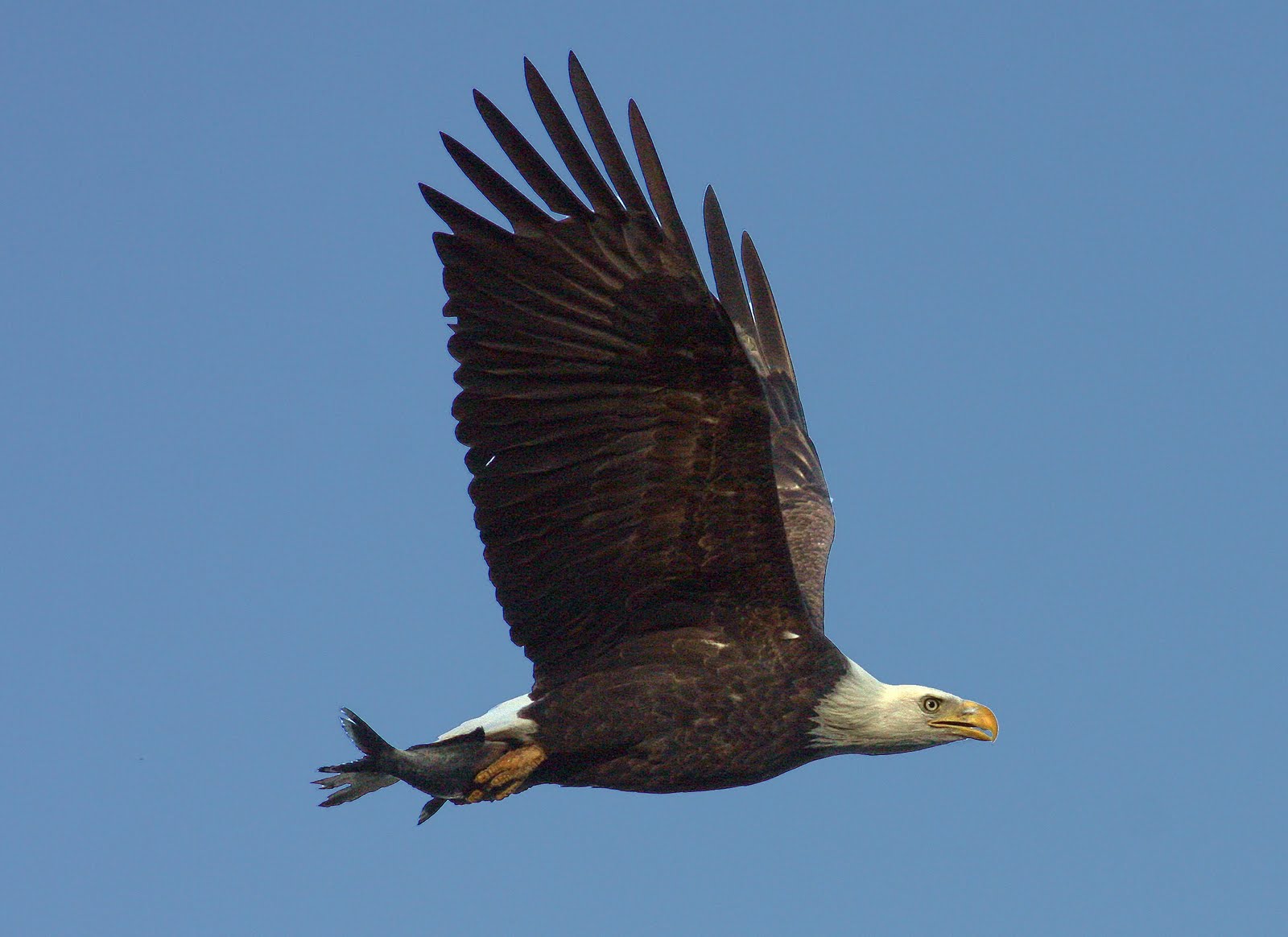
Each year in the weeks leading up to Thanksgiving, eagles by the score congregate at the base of the Conowingo Dam which spans the Susquehanna River just south of the Pennsylvania state line.  Thanks to the constant flow of water through the dam’s huge electric generating turbines, the eagles are attracted by the plentiful bounty of large fish and the guarantee of open water even on the coldest of days.  And they, themselves, have become the attraction for a growing number of photographers, birders and families hoping to catch a glimpse of a bird that was on the verge of extinction just a few years ago.

Dam Eagles
It’s a patriotic thing,” says Mary Lynn Rathman, who lives near Reading, PA, and drove more than an hour south to watch the eagles.   “We heard about it on our local radio station.  It’s something that we almost lost, and now they’re coming back. It’s just exciting to see”

As she speaks a pair of adult eagles, instantly recognizable with their luminous white heads and tails, bright yellow beaks, and chocolate brown bodies are engaged in a dog fight of sorts over the river, twisting and turning with surprising agility for birds with a wingspan that may approach 8 feet. Juvenile birds are also in abundance, their dull brown heads still waiting for the white feathers that won’t begin to appear until they reach sexual maturity at about five years of age.

Wind Beneath The Wings
 It’s the very presence of those juveniles that speaks to the eagle’s amazing recovery from the brink of extinction. In the early 1960’s scientists estimated there were fewer than 500 pairs of nesting eagles left in the lower 48 states. Their population had been decimated by the well-publicized ravages of DDT and other industrial pollutants.  After DDT was banned in 1972, eagle populations began to rise quickly, and today there are believed to be more than 9,000 active nests across those same 48 states. Maryland alone has nearly as many breeding pairs today as the entire country did in the species’ darkest days.  In 2007, the eagle was removed from the federal Endangered Species List.

Dinner on the Fly
Mary Lynn and Dave Rathman came to Conowingo armed only with two pairs of binoculars, and their shared desire to see an eagle on the wing.  But for the small army of photographers gathered by the river, the trip to Conowingo is a visit to a photographic Valhalla.

For much of the past 50 years, photographers hoping to catch a shot of an eagle in flight would have to travel to distant, remote places where the birds had managed to establish a precarious foothold despite their declining numbers. Today, it’s just a matter of parking your car in the lot at the base of the dam, moving your tripod a few feet to the fence at the edge of the water, and waiting.

Eagle Watchers
“I’ve been here seven of the last nine days,” says one bearded tripod-toter.  And while some armchair photographers carry only small point and shoot cameras to document their eagle encounters, others come armed with pricey cameras equipped with long, ultra-expensive telephoto lenses that are pointed into the sky like a battery of anti-aircraft guns, protecting against squadrons of avian invaders.

Diving Eagle
Burke Seim, who owns Service Photo, one of the last remaining independent camera stores in Baltimore, simply shakes his head when asked about the photographers’ willingness to spend so much. “I ask them why they want this expensive lens, and they tell me…to shoot eagles.”  It’s a refrain he’s hearing more and more these days as word of Conowingo’s plethora of willing subjects filters through the photographic community.
 
“A little over seven thousand dollars,” says Charlie Lentz, a retired banker, when asked how much his 500mm lens cost.  Lentz jokes his wife warned him that the actual cost to the familily’s  bottom line would be much more expensive.

 “It’s really going to cost you 14 (thousand),” Lentz says she told him. “If you spend seven, then I’m spending seven!”   But Lentz is quick to add, “She was just kidding….I think.”

Lentz’s outlay may still be a bargain compared to some of the other dedicated photographers lining the river’s edge whose combination of high-end digital camera bodies and lenses can easily mean they have more than $20,000 perched atop their tripods.

Eagle in a Hurry
Having all of those photographers gathered together in one flock can also provoke some serious lens envy. “No question about it,” says Lentz.  “You got a 500(mm), you want a 600, and there’s a couple of 800s that float around here occasionally. You never have enough.  All it takes is money.”

For the photographic horde, most of the day is spent playing a waiting game, as the birds they’re after remain tantalizingly just out of lens-reach on rocky outcrops several hundred yards across the river.  But when an eagle on the wing finally approaches the photographic phalanx, there is an almost deafening cacophony of clicks and pops from the high-speed shutters clicking into action and taking as many as 6 or 10 shots per second.

Head On

The Grab
On the Prowl
“Sometimes I come up here and take a thousand photos a day,” says Lentz, who knows most of those will be out of focus, poorly composed, or improperly exposed.  “If you go home and you have one good shot you feel at least it’s been a successful trip.”

And then, as the light begins to fade, and the photographers begin to collapse their tripods and pack up for the trip home, Lentz repeats the photographic mantra that will have many of them standing in the same spot tomorrow. “What keeps you coming back is constantly trying to get that shot that you have difficulty getting…the shot of a lifetime.”
--
  All photography by Bill Vanko / Vankovision.com

_________________________

Bill Vanko's Bio:

Bill Vanko is an award-winning reporter and broadcaster whose profession is news, but whose passion is photography.
Trained as a zoologist, he made a fortuitous wrong turn on the way to the unemployment line, and launched a career in broadcasting instead.. Since then his assignments as a network and local news anchor and reporter have carried him all around the world to places where news was being made. And always, he took his camera along.
Bill’s love for the natural world around us endures in his collection of more than 30 thousand photographs of bugs, birds, bats, snakes, sharks, squirrels, flowers, fish, friends and anything else that will sit still long enough for him to press the shutter button.
He is the co-anchor of Maryland’s Morning News on WBAL Radio (1090AM) in Baltimore, and can be heard each weekday morning beginning at 5am.
You can see more of his photographs at his web site: www.vankovision.com .
__________________________________

Please Note:
*** This Blog Needs Your Story! *** { I'm Serious!} If you have a story to post on this theme, contact me, please! We have only one possible story on tap. Give your imagination a stretch--your story can be about any sort of Relentless Pursuit, fact, fiction, poignant, or humorous. I'd love to hear from you and work with you on your story! And we need to keep this theme going! And if you have a few moments, please stop by my web site and have a look around.
_________________
[Click on the green SU icon below to recommend this blog to Stumble Upon Members]
----------------------
##

Friday, September 2, 2011

Philadelphia Folk Fest: 50th Year

Michelle Alton
Well, I am fresh out of stories this week with two slightly vague promises waiting in the wings.  You are all weary of either living through Hurricane Irene, or just hearing about her, so I will forego telling the story of what could be the epilogue of "Water Torture," because, as you already suspect the recalcitrant damned leak did come back.  And a handful of huge trees DID fall down around us.  Perhaps a story for another day.  So I thought I would take a slight turn off the beaten path and just show you some photos I shot on the last day of the Philadelphia Folk Festival (last week in August) and include some narratives about the relentless search for the 1960's that I observed until, soaked to the bone, I slogged back in the sheeting rain to the parking lot.   I hope you enjoy these!

--
  Michelle Alton

__________________________

Thanks for stopping here to see the latest post. I'd love to know what you think of the "Relentless Pursuit" series. Please leave me a comment below or email me with your suggestions on what you'd like to see on this blog. Also, PLEASE click the green SU icon at the bottom of this post to recommend the blog to Stumble Upon members. It will dramatically increase the "exposure" of our authors' work.


If you have a story to post on this theme, contact me. And be sure to take a look at my Photography site. I'd love to hear from you! Also, consider forwarding the link to "Relentless" to your friends and family. Thanks again!


__________________________
Philadelphia Folk Festival: 50th Year
(Click photos to enlarge and then click your browser's back button to come back)

I had decided to forfeit the $80 I had paid for an afternoon/evening ticket for the last day of the Philadelphia Folk Festival in Schwenksville.  Torrential rains were suddenly predicted and well, you could describe me in a lot of ways, but when I try to describe myself, I do it in one word:  Goldilocks!   I'm fine as long as it's not too hot, not too cold, not too wet, not to arid, and as long as I have a hot shower and a comfy bed with clean sheets and four pillows.  "Intrepid" would not be me.

But the sky was blue and the temperatures were mild when I decided to set forth.  It would be a 50-mile drive.

An uneventful trip ended up in a soggy overflow parking lot about a mile from the Main Event.  The traffic controllers allowed me to park there because I had four-wheel drive.  Oh boy, this was going to be fun! 

I had a backpack with citrus green tea, a folding umbrella,  a few basic bits of camera equipment, and two plastic grocery bags, in case I had to cover my camera in a downpour.  I was wearing sturdy Mephisto walking shoes (and socks) and I had a tiny fanny pack with about $50, my driver's license, and my insurance card.  And of course, my trusty Canon 7D DSLR and my versatile Tamron 18-270 mm zoom lens. 

After parking the car, and shooting a photo of the immediate surroundings (I did not have bread crumbs to drop) so I could find the car again on the way back, I followed the crowd walking in the rural road.  Already it was feeling "Woodstock-esque," as I encountered headbanded, tie-dyed, mud-encrusted people carrying huge back packs, or pulling giant wagons that seemingly contained all of their belongings.

All along the Festival Route, people had home-made signs on their lawns offering all-day parking for $10, and there were signs posted along the roadside, advertising some of the acts and goodies for sale at the fest.

And then there was this wonderful roadside Lemonade Stand:

Lemonistas
Finally I entered the onsite parking lot for the Festival. It was full to the brim with cars, and its perimeters were marked by about twenty or thirty large Sanitation trucks, there to service the dozens of "Porto Potties" on the grounds. The facilities were plentiful, clean, and well maintained. Whew! In fact, everything was so well organized and well thought out that I found myself happy that I had made the trip. And the sun was still shining, with beautiful wispy white clouds making everything beautiful.

The first thing I encountered inside the festival grounds was a large tent, with a small performance stage at one end. A group of musicians were playing, and people, old, young, big, and small, were either swaying with the music, parked on sand chairs or sitting on plastic tarps.


In the Performance Tent


All her belongings, seemingly abandoned..

And right outside the tent a local radio station was handing out watermelon wedges.

Watermelon Woman


I decided to try to find the other stages, and walked past the area designated for arts and crafts vendors, then past the food court, and finally, there were two more stages and a pathway to the woods, with a sign that said "Dulcimer Grove."

Dulcimer Grove
Inside the wooded grove hung dozens of colorful hammocks, strung between trees.  Kids played with hula hoops and yo yos, and adults snoozed or engaged in cozy conversations.

Forty Winks in Dulcimer Grove


Relaxing Together


Another Forty or so Winks


Hammock Man
Later I learned that nearly all the hammocks had been acquired from one of the festival vendors, for $35 each.  A bargain!

Outside Dulcimer Court, folks were already staking out their spots for the evening performance on the Main Stage.  There were reserved seats, and then there were seats on the grass.  All would soon be in the rain!


Camped Out in front of Main Stage
On the far side of Dulcimer Grove was the Camp Stage, and I arrived there just before the "Celtic Afternoon" was about to begin. The skies were darkening, but folks didn't seem to care. The Philadelphia school teacher who had become my buddy was sitting on the grass beside me, with no protection but a baseball cap. He did not care. He got soaked. Others suddenly covered themselves with black plastic bags, blue tarps, rain gear, and whatever protections they had improvised. The Battlefield Band did not disappoint. Shirtless, tattoed, and painted 60s throwbacks were dancing in the muddy isles. Everyone was happy, despite the downfall.


Camp Stage Audience

What better way to hold a tarp down?

And then suddenly OUT CAME THE SUN!  I decided to explore the vending areas, as there was an hour before the evening's final performances on the Main Stage.  I had really come to see Gene Shay, the Philly DJ who had been the EMCEE since the first festival in 1962, and to hear Levon Helm and his band.  THAT was not going to happen for me!

On the loudspeaker, someone suggested an interesting refreshment:  Iced coffee with a scoop of mint chocolate chip ice cream at the bottom.   I  rushed to the Ice Cream Concession.  Wow!  That was delicious, and a treat I'd recommend highly.


Martin Guitar Contest

I passed the Martin Guitar tent, where they were holding a contest in which the winner would go home with a new, beautiful Martin acoustic guitar.


They will Come  Martin Guitars (and other instruments) were hanging from the sky.

Grizzly Adams?  Or just another 60's "Throwback?"

Jugglers in Dulcimer Grove
A mother and daughter were relaxing on a blanket, as each checked their messages.

Texting 101
And a ceramics artist provided clay for the little kids to play with.  It reminded me of my childhood when my Jewish grandmother would come to bake strudels for us.  She would give me little bits of dough to roll into long fat worms, and then twist into little sugared cookies that she called "feygelas."  Don't ask!


Making "Feygelas"


Tie Died
Who knew that tie dying was big again?

Tie Dying is Big
And finally the Main Peformance was about to begin. But suddenly the the skies opened like nobody's business. Three inches of rain fell in the first hour.

Singing' in the Rain

It was only minutes before my umbrella turned inside-out and I became soaked to the skin.  Luckily my camera was high and dry, and wrapped in my Acme grocery bags.
I took one last look at Dulcimer Grove before slogging through the thick mud and down the long road to my car (in the muddly parking lot), all the while making plans to return next year.  Anyone want to join me?

Cocktails in Dulcimer Grove

--
  All photos by Michelle Alton


______________________


Please Note:


*** This Blog Needs Your Story! *** { I'm Serious!} If you have a story to post on this theme, contact me, please! We haven't a single story on tap. Give your imagination a stretch--your story can be about any sort of Relentless Pursuit, fact, fiction, poignant, or humorous. I'd love to hear from you and work with you on your story! And we need to keep this theme going!  And if you have a few moments, please stop by my web site and have a look around.


___________________


[Click on the green SU icon below to recommend this blog to Stumble Upon Members]

##